Sometime four years ago, I was sitting in on a customer call - one of those long ones where an IT manager walks you through everything wrong with their current setup - and he said something that stuck with me. "We have 800 devices across four cities and I genuinely don't know what's on half of them."
He wasn't embarrassed saying it. That was the part that got me. He'd just accepted it as the natural state of things.
That conversation is why I keep coming back to the MDM story. Not because it's technically fascinating - though it is - but because it's really a story about how long it takes organisations to take something seriously. And what it costs them in the meantime.
Before Anyone Was Paying Attention
Picture a sales rep in 1999 with a Palm Pilot. He's got your whole client list on it - no password, no encryption, nothing. He leaves it in a cab. That data is just gone. Your IT team had no way to lock it, wipe it, or even know the thing existed.
Here's what gets me though: nobody thought that was a crisis. It was just how things were.
Device security in the late nineties was mostly a strongly worded memo and a prayer. Companies were way more worried about Y2K than about what was sitting unencrypted in someone's jacket pocket. The concept of "managing" a mobile device hadn't really formed yet. Devices were personal property. Data would sort itself out.
It didn't, obviously. But it took a while for the industry to admit that.
The first MDM tools showed up in the early 2000s and they were, to put it kindly, rough around the edges. Mostly built around BlackBerry because that's what serious enterprise people used back then. You could push an email configuration, enforce a PIN policy, wipe a device remotely if it went missing. That was about the extent of it. But even that was a real step - for the first time, an IT team could actually do something when a device walked out the door.
Three Phases, Each One a Surprise
People like to draw clean lines through tech history. The reality is usually messier. But MDM did go through three fairly distinct phases - and each one was kicked off by something the industry wasn't quite ready for.
2000–2010: Don't lose the device, full stop. On-premise servers, company-owned hardware, basic policy enforcement. IT's job was simple: know what you own, lock it down, wipe it if it disappears. Everything lived behind the firewall. A BlackBerry fleet was about as complicated as things got.
2010–2020: The iPhone walked in and nobody was ready. Employees showed up with personal iPhones and just... started using them for work. Nobody asked permission. MDM scrambled to the cloud, added containerisation and app management, and spent the better part of a decade trying to draw a clean line between "corporate data" and "personal phone" on the exact same piece of hardware. That line was never really clean. It still isn't.
2020–now: Every screen became IT's problem. Laptops, tablets, kiosks, IoT sensors, point-of-sale terminals. The word "mobile" in MDM started to feel a bit quaint. Then a pandemic sent everyone home at once and suddenly all of this became urgent in a way it had never quite been before.
The iPhone Did What No Policy Could
When Apple launched the iPhone in 2007, enterprise IT did not send Cupertino a thank-you card.
Within a few years, employees were connecting personal smartphones to corporate Wi-Fi without asking anyone. Android followed close behind. The neat, manageable world of company-issued BlackBerries - where IT owned the hardware, controlled the software, and could enforce whatever policy it liked - fell apart completely. Now you had hundreds of personal devices, running different OS versions, made by different manufacturers, all touching corporate data, none of them owned by the company.
The old approach broke immediately. You can't wipe someone's personal photos because they resigned. You can't install a monitoring agent on a device that belongs to an employee without a fairly serious HR incident. The boundary between someone's work life and personal life ran right through the middle of a single device, and nobody had a clean answer for it.
What the industry landed on was containerisation. The idea was straightforward - build a secure, encrypted workspace on the device that holds all the corporate apps and data, managed entirely by IT, while leaving the personal side completely untouched. Work email in the container. Holiday photos outside it. Employee leaves the company? IT deletes the container. Their personal phone stays exactly as it was.
It wasn't a perfect solution. Some employees hated the idea of their employer having any foothold on their personal device at all, even a contained one. But it worked well enough to become the standard, and it's still the foundation of most BYOD management today.
The Part Where Everyone Got Confused by Acronyms
If you've spent any time in this space, you've hit the acronym wall. MDM. MAM. MCM. EMM. UEM. It feels like every few years somebody invents a new three-letter abbreviation, the analyst firms write about it extensively, and the whole industry pivots accordingly.
Here's my honest read on it: the core problem never actually changed. What changed was the scope of what counted as a device that needed managing.
Mobile Application Management - MAM - came out of the need to control specific apps rather than entire devices. Useful when you're dealing with personal phones you can't fully lock down. Mobile Content Management handled documents and files specifically - preventing sensitive attachments being forwarded outside the organisation, managing access to cloud storage. Then someone bundled all of it together, added identity management, and called it Enterprise Mobility Management.
Then "mobility" started feeling too narrow as laptops and desktop computers entered the picture - because of course they did - and it became Unified Endpoint Management.
I'm not being cynical about the rebranding. Each rename mapped to a real expansion in what IT teams were actually being asked to handle. BlackBerries to iPhones to MacBooks to the smart TV bolted to the conference room wall that nobody can remember the password for. The scope genuinely grew. The terminology tried to keep up.
That said - if you're new to this space and feel slightly overwhelmed by the alphabet soup, you're not missing some profound distinction. The industry just has a habit of repackaging the same underlying challenge every five years and handing it a fresh name.
When Security Stopped Being a Talking Point
For most of its early life, MDM was primarily an operations and compliance story. Track the devices, enforce the policies, keep the audit logs tidy enough to satisfy whoever's doing the next review. Security was in the pitch deck, but breaches felt distant. The kind of thing that happened to companies that weren't paying attention.
That changed around the mid-2010s, and it changed fast.
Endpoints - not the network perimeter, not the server room, the actual device sitting in someone's bag on the train - became the primary way attackers got in. And then hybrid work arrived and made the problem structurally worse. If your workforce is connecting from home broadband, hotel Wi-Fi, and coffee shop networks, the old model of "inside the firewall equals safe" is just fiction. There's no perimeter anymore. There's only devices, everywhere, connecting to things constantly.
Zero Trust became the framework the industry landed on. The concept is deliberately blunt: assume nothing is safe by default. Every access request from every device gets verified, every time - not just at login, but continuously. Device health, patch status, user identity, location, behavioural patterns. A phone running an OS that's three months out of date doesn't get into the corporate CRM. No exceptions, no manual override, no "just this once for the regional manager."
For IT teams who spent years sending gentle reminder emails asking people to please, please just update their phones - that shift to automated enforcement was genuinely significant. It moved the conversation from "we have a policy written down somewhere" to "the policy actually executes." Those are very different realities.
The Industries That Pushed This Hardest
MDM didn't evolve at the same pace everywhere. A few sectors pushed much harder than the rest, usually because the cost of getting it wrong was uncomfortably high.
Healthcare was relentless about it from early on. HIPAA compliance combined with the genuine clinical need for doctors and nurses to access patient data on mobile devices created a very specific, very demanding set of requirements. Geofencing - the ability to restrict what data can be accessed depending on physical location - became a real MDM feature largely because hospitals kept asking for it. Audit trails that could hold up under regulatory scrutiny became non-negotiable. Healthcare shaped a lot of what we now consider standard MDM functionality.
Education brought a different kind of pressure: pure scale, and the political complexity of managing devices that technically belong to students or their families. A district rolling out ten thousand Chromebooks cannot have IT manually configure each one. Zero-touch deployment stopped being a nice-to-have and became essential. Then COVID hit, and every school system in the world suddenly needed functional remote device management within weeks. The ones that had invested in it looked prescient. The ones that hadn't looked very, very stressed.
Retail and logistics pulled MDM into hardware categories most consumer-focused vendors had never seriously considered - warehouse barcode scanners, delivery management handhelds, point-of-sale terminals running Android builds that were outdated the moment they shipped. Managing a fleet of ruggedised warehouse devices is a completely different problem from managing executive iPhones, and the platforms that recognised that early built durable competitive advantages in those verticals.
Where Things Actually Stand in 2026
The IT manager I mentioned at the start - 800 devices, no idea what's on half of them - that is a solvable problem now in ways it genuinely wasn't a decade ago.
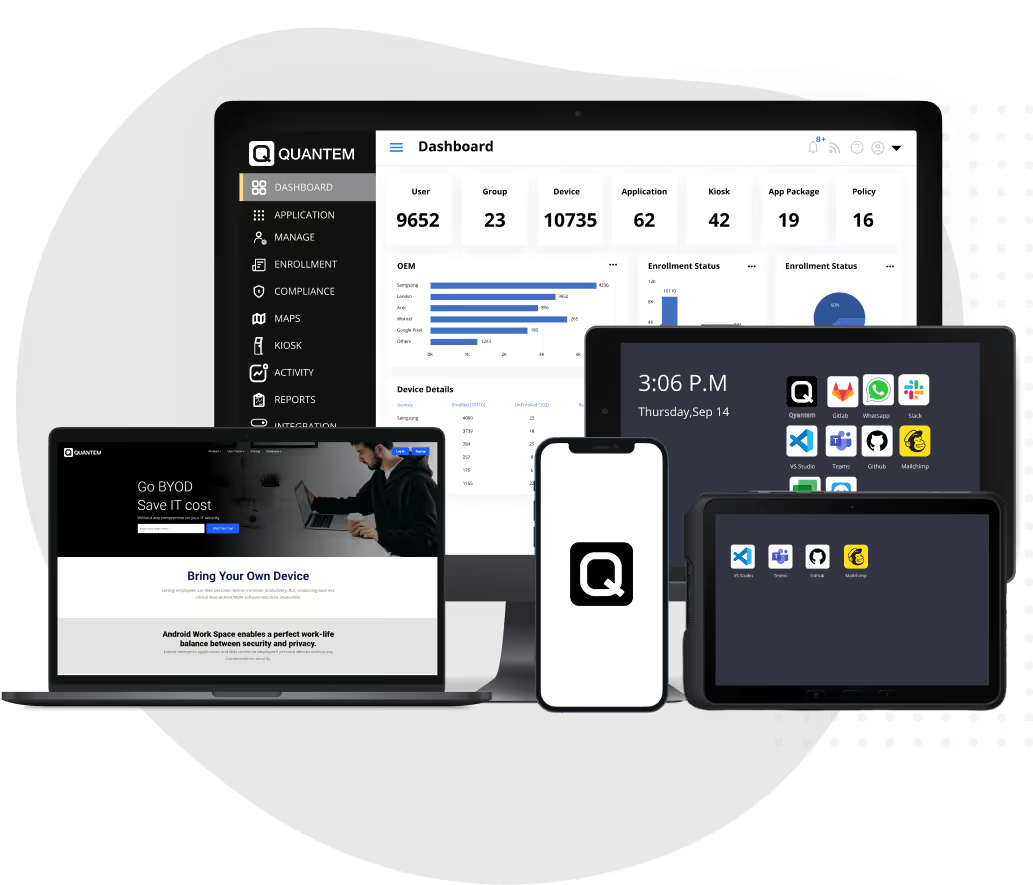
Zero-touch provisioning means a device can ship directly from a warehouse to an employee's home and configure itself the moment it's switched on. Right applications installed, right policies applied, right network access granted - no IT team involvement, no imaging session, no setup call. That capability would have seemed genuinely implausible to the person manually flashing laptops in a server room in 2008. It's the kind of thing we built Quantem to do well, and watching IT managers realise they don't have to touch every device individually is still one of the better parts of this job.
AI-assisted anomaly detection means a device suddenly accessing files it's never touched before, or logging in from an unfamiliar country at 3am, surfaces as an alert before it becomes an incident - not after. Conditional access can automatically quarantine a non-compliant device without waiting for a human to notice something is wrong.
The market has caught up to how central all of this is. MDM sits at around $13.5 billion globally and is growing fast. It's not a specialist discipline anymore. It's baseline infrastructure - in the same category as email and identity management, things organisations can't really function without.
What Comes Next
The scope keeps growing. That's probably the only honest thing to say about where this goes from here.
AI-enabled edge devices - smart cameras, industrial sensors, connected vehicles, equipment on factory floors - are creating a new generation of endpoints that don't look like phones or laptops but still sit on corporate networks and handle sensitive data. Managing them requires protocols and ways of thinking that current UEM platforms are only beginning to work through properly.
MDM is also converging fast with broader security infrastructure. The boundaries between device management, network security, and identity management are dissolving. In five years the question might not be "which MDM solution do you use" but "how does your security stack handle endpoint management." The function will still be there. The category label might be gone.
What stays constant is the tension underneath all of it. Corporate data lives on devices that organisations don't fully own, used by people whose behaviour can't be fully predicted, in locations nobody can see. MDM has become very good at living with that tension. It hasn't resolved it, and I'm not sure it ever fully will.
That's the problem the Quantem team works on every single day. And honestly - that's probably why, despite my early suspicion that this was a boring topic, I keep finding it worth writing about.

Get the latest blogs directly delivered to your mail fly arrow